Three pillars. One decision layer.
Messy claim in. Governed decisions out. Deterministic gates, one agent that delegates, your thresholds at every step.
See ClaimOps doing the work.
Real ClaimOps screens, in the order a claim lives them. Pick a chapter, or let it play through.
What is arriving, what is clearing, what needs a person.
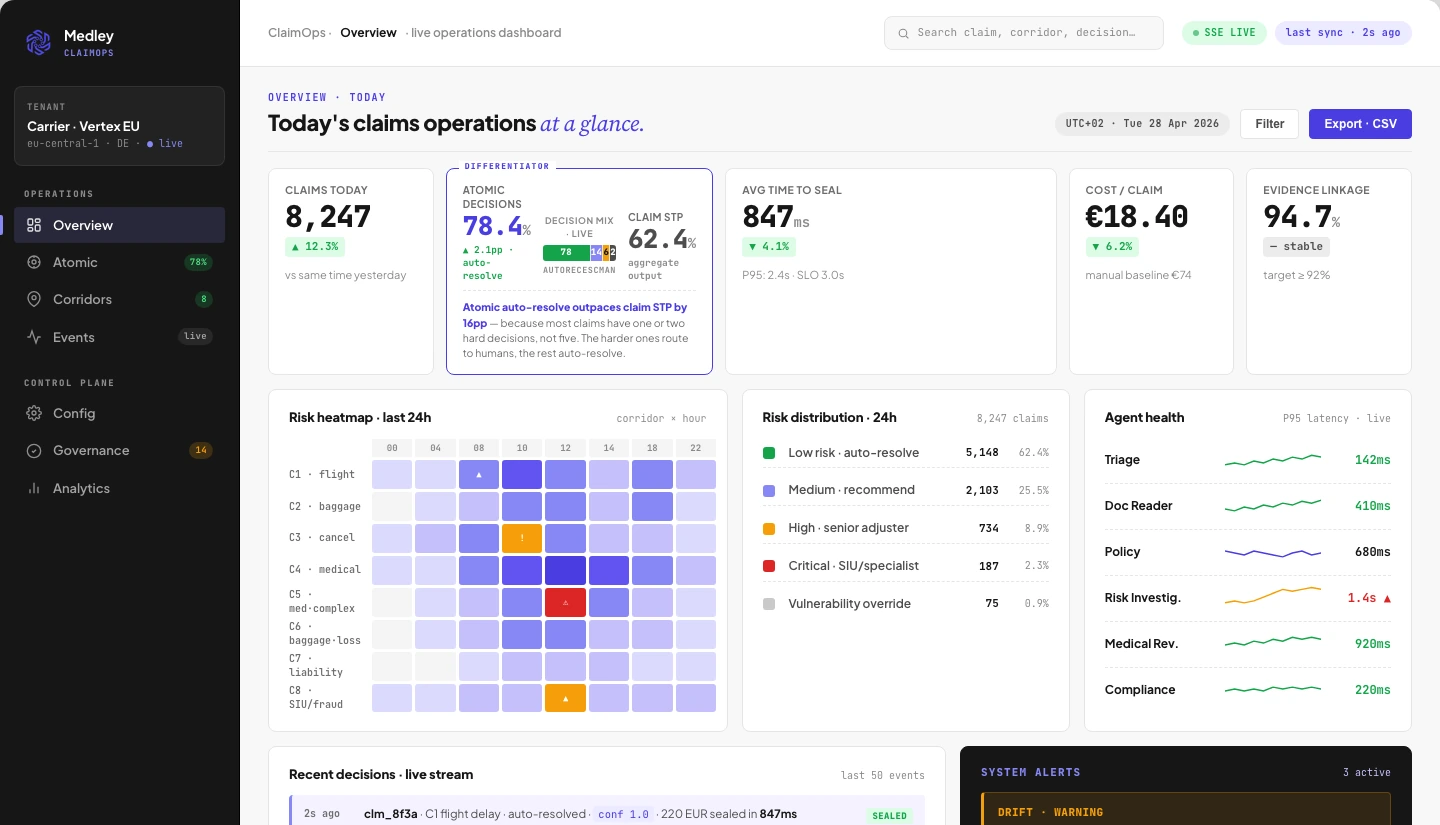
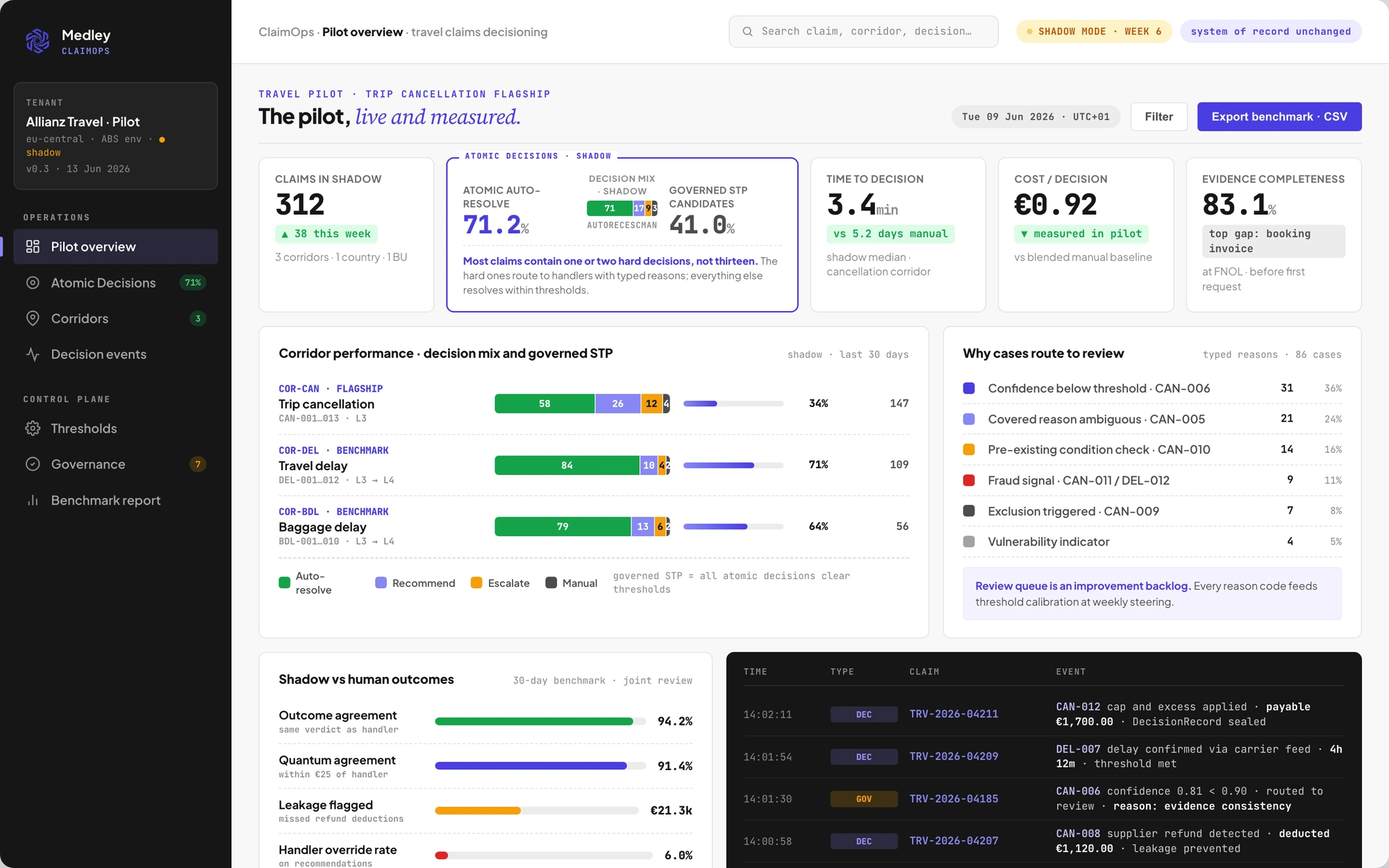
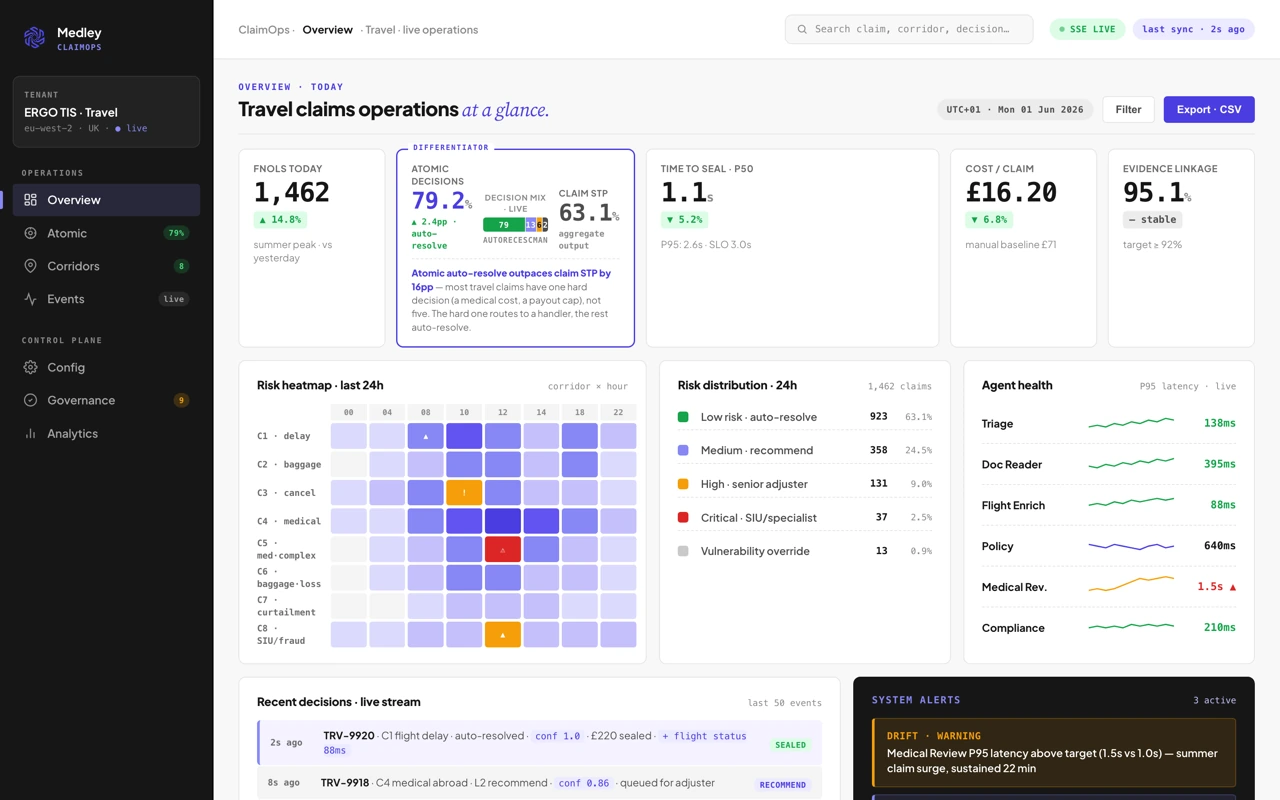
One agent. Delegates, checks, signs.
Not a crowd of bots, each with an opinion. One agent owns every decision. It splits the claim into atomic calls, hands each to the right skill or the right person, tests what comes back against your thresholds, and goes round again until the evidence clears the bar. What it cannot explain, it does not sign.
- PlanTrip cancellation · 5 decisions to make
- DelegateDocuments · 4 documents read · 11 fields out
- DelegatePolicy · Cover in force at booking · 11 Jan
- DelegateFraud · Fraud signals within tolerance
- CheckPre-existing condition · 0.62, floor 0.85Short · go again
- Pass 2PlanRe-plan · test the endorsements
- DelegateCoverage · Pre-existing waiver found
- DelegateRecovery · Airline refund confirmed · €1,240
- CheckFive of five clear · €2,840 under the €5,000 capClears
- SealSigned · every step replayableSealed
When the evidence will not clear, the last delegate is a person. The claim reaches your adjuster with the question it could not answer already written down — never a guess dressed up as a verdict.
Mess in, structure out.
FNOL arrives in any shape: PDF, photo, voice note, video. Medley extracts, validates and vulnerability-flags before any decision logic runs.

Add the right context.
Policy at the exact loss date. Endorsements intact. External data through EU-residency-pinned proxies. Degraded-mode fallback so nothing blocks the pipeline.
Autonomy earned, not claimed.
Rules at the bottom, living agents at the top. Each gate graduates on its own accuracy, drift and fairness metrics. You sign every level-up.
Five levels. You set the ceiling.
The architecture earns the next level. You approve it. Each gate moves independently, so travel flight-delay can run at L4 while liability stays at L2.
- Who decides
- Deterministic gates decide
- Who reviews
- Adjusters review every claim
- Models
- No model in the decision path
- Who decides
- Models score and recommend
- Who reviews
- Adjusters confirm each verdict
- Models
- Pinned prompts, locked versions
- Who decides
- Auto-resolve above threshold
- Who reviews
- Adjusters work the exceptions
- Models
- Replay-tested thresholds
- Who decides
- Agents act within authority caps
- Who reviews
- Humans on the loop, sampled
- Models
- Canary rollout, auto-rollback
- Who decides
- Agents propose threshold updates
- Who reviews
- You approve every change
- Models
- Learning Loop, signed
Three layers wrapping every decision.
Communications, external data integrations and the Learning Loop run beneath all three pillars. Invisible, indispensable.
Comms
Tone-aware, deduplicated, paced. A vulnerability override changes cadence and language automatically. Regulator-compliant by default.
Data
EU-residency pinned. Region-locked proxies. Every external data fetch creates a timestamped entry in the decision trail. No unbounded model calls.
Learning Loop
Closed claims propose threshold updates. You approve every one. The system earns autonomy — it doesn't claim it.
See it on your data.
One corridor, 90 days, production STP. Fixed scope and fee.